
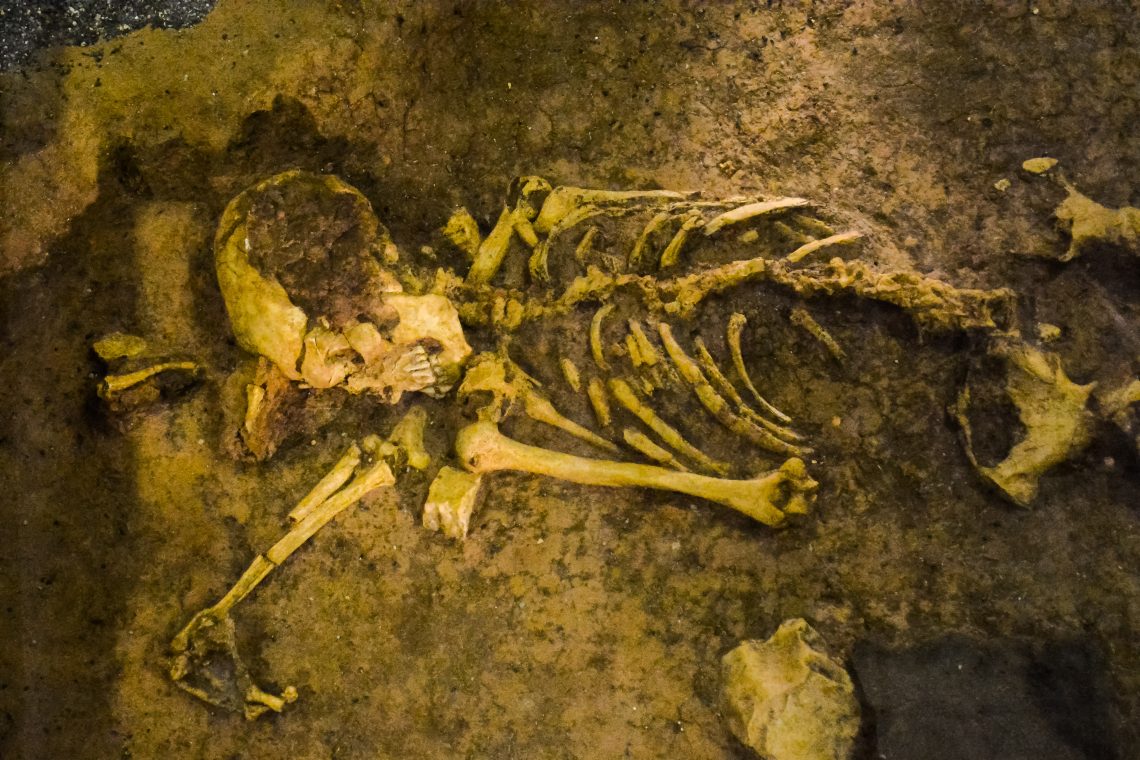
Two women buried 7,000 years ago in a Libyan rock shelter have no business being genetically mysterious.
They lived during the African Humid Period — a stretch of millennia when the Sahara Desert transformed into a green savannah threaded with lakes, rivers, and grasslands that supported human settlements, fishing, and livestock herding across what is now one of Earth’s most unforgiving landscapes.
Yet their DNA, pulled from naturally mummified remains at the Takarkori rock shelter, tells a story that flies in the face of what researchers anticipated. The genomes reveal that these pastoralist herders belonged to a previously unidentified North African lineage — one that had remained sealed off for tens of thousands of years, showing no meaningful genetic input from sub-Saharan communities to the south or from Near Eastern and European groups to the north.
The findings, laid out in a new study published in the journal Nature, shatter the long-standing assumption that the Green Sahara functioned as a migration corridor linking African populations. “This suggests they remained genetically isolated despite practicing animal husbandry, a cultural innovation that originated outside Africa,” said Johannes Krause, a geneticist at the Max Planck Institute for Evolutionary Anthropology and the study’s senior author, speaking to Reuters.
A Lineage Frozen in Time
The Takarkori individuals carry ancestry that branched away from sub-Saharan African populations roughly 50,000 years ago — right around the same period when modern human lineages began fanning outward from Africa into the Middle East, Europe, and Asia.
Krause described the genomes as “almost like living fossils” in conversation with BBC Science Focus. “If you’d told me these genomes were 40,000 years old, I would have believed it,” he added. The Max Planck Institute’s official release noted that this newly described lineage held firm in isolation, pointing to deep genetic continuity in North Africa stretching back to the late Ice Age.
The genetic seclusion preserved within these two women — both in their forties at the time of death — appears to have defined their lineage throughout its entire existence. When researchers examined their Neanderthal ancestry, they found only faint traces: roughly 0.15 percent of the genome.
That number sits ten times lower than what turns up in Levantine farmers and other populations outside Africa. It is, however, measurably higher than what present-day sub-Saharan African genomes carry — hinting at ancient but extremely limited contact with groups beyond North Africa’s boundaries.
Herders Who Learned Rather Than Migrated
Archaeological work at the site, nestled in the Tadrart Acacus Mountains of southwestern Libya near the Algerian border, has uncovered a rich and layered record of human presence. The rock shelter holds 15 burials spanning from Late Acacus hunter-gatherer-fishers around 10,200 years ago through a long Pastoral Neolithic period that wound down approximately 4,200 years ago.
The two women chosen for ancient DNA analysis came from the Middle Pastoral Period. Their remains were naturally mummified, with skin, ligaments, and soft tissue still preserved. Excavators also brought to light stone tools, wooden implements, bone artifacts, pottery, woven baskets, and carved figurines from within the shelter.
The genetic results settle a debate archaeologists have circled for years: did pastoralism sweep across the Green Sahara through waves of migrating herders, or through the slower spread of ideas? The Takarkori genomes point squarely toward cultural diffusion. Local communities absorbed livestock herding techniques — including the management of goats and sheep — without being genetically displaced by outside groups.
Nada Salem, a researcher at the Max Planck Institute for Evolutionary Anthropology and the study’s lead author, said the discovery “reveals how pastoralism spread across the Green Sahara, likely through cultural exchange rather than large-scale migration.”
Rewriting the Taforalt Equation
The Takarkori genomes also cast new light on a much older North African population. The 15,000-year-old foragers from Taforalt Cave in Morocco, linked to the Iberomaurusian lithic tradition, have long left geneticists searching for answers. Earlier research modeled Taforalt ancestry as roughly 63.5 percent Natufian from the Levant and 36.5 percent from an unidentified sub-Saharan African source.
The new analysis fills in that blank. The African ancestry within Taforalt individuals now appears to trace back to a Takarkori-like North African lineage rather than any sub-Saharan population. The updated model places Taforalt ancestry at approximately 60 percent Natufian and 40 percent Takarkori-related.
Both the Takarkori and Taforalt groups sit at equal genetic distance from sub-Saharan African lineages. That shared distance signals that even as the Sahara bloomed with vegetation and water, meaningful gene flow between North African and sub-Saharan populations simply did not happen. The desert’s greening never became a human migration highway.
Traces That Survived the Desert’s Return
The Takarkori lineage itself faded around 5,000 years ago. The African Humid Period drew to a close, the Sahara reclaimed its arid character, and this isolated population vanished from the archaeological record. But their genetic fingerprint did not disappear entirely.
Modern North African groups still carry echoes of this ancestry. The study also detected a notable genetic closeness between the Takarkori lineage and certain Sahelian communities, including Fulani herders spread across multiple countries — a connection that aligns with archaeological evidence showing pastoralist groups shifted southward from the Central Sahara as the land dried. Researchers admitted surprise at the absence of gene flow, given how widely the Green Sahara corridor theory had been accepted.
Mary Prendergast, an anthropologist at Rice University who had no involvement in the research, wrote in an accompanying commentary that studies like this are “just beginning to reveal Africa’s complex population history, uncovering lineages barely detectable in the genomes of present-day people.” She added that “even small sample numbers can shape our understanding of the past.”
The human remains from Takarkori are preserved and curated at the Museum of Anthropology of the University of Rome, La Sapienza.