
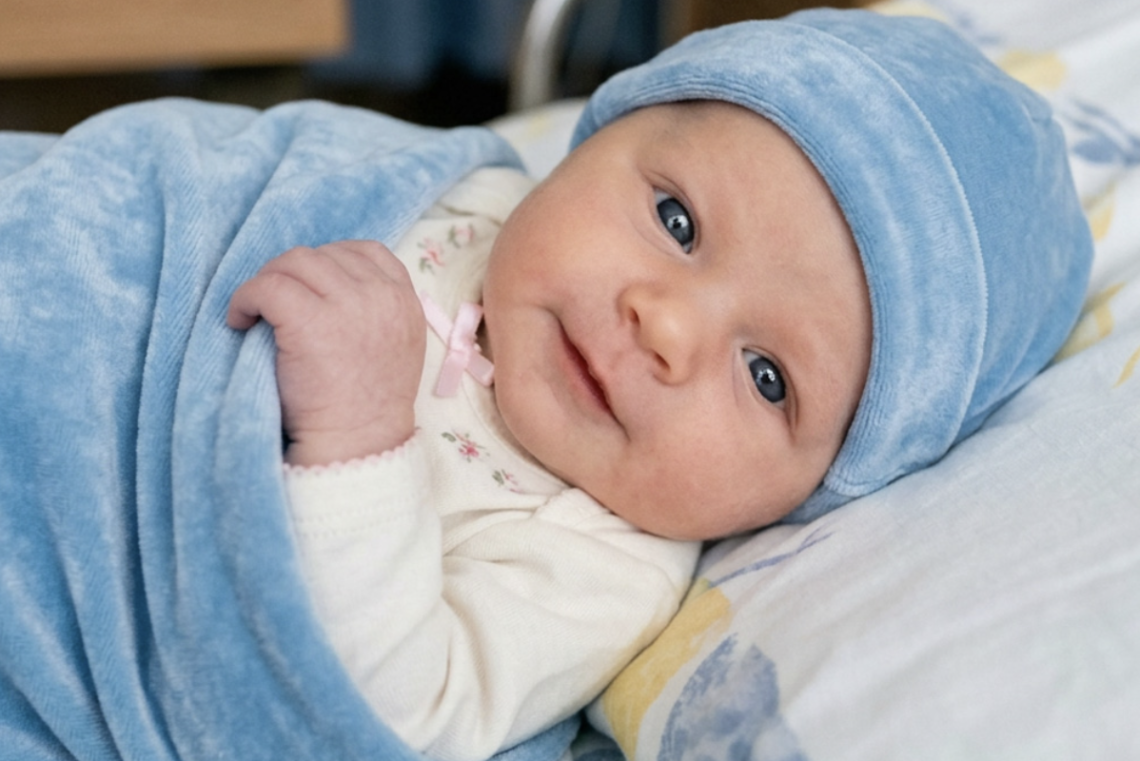
I’m still trembling as I write this. Honestly, sleep has barely touched me since last Thursday — maybe a few scattered hours at best. You know how long we waited for Sophia. A full decade. Ten years of hormone injections, of sobbing into pillows after every negative result, of feeling like my own body had turned against me and declared me unworthy.
When we finally brought her home, I moved through the house like I was made of glass. I kept my voice low and my joy quiet, almost superstitious about it — as if celebrating too loudly might somehow alert the universe that something had gone right for us, and it would swoop in to correct the mistake. But there she was. Our daughter, breathing softly in her crib.
Then came the first bath.
This was supposed to be one of those moments you frame in your memory forever, right? The tender, clumsy, beautiful beginning of parenthood. Daniel was extraordinary — you know how he gets, so careful and deliberate about everything. He cradled the back of her tiny head in one palm and trickled warm water over her with a little plastic cup, like she was something precious and breakable, because to him, she was.
And then he went completely still.
The cup tilted. Water spilled over the edge of the tub. He didn’t move, didn’t speak, didn’t even seem to breathe. “Daniel,” I said, but it was like calling into an empty room. His eyes were locked onto a spot on her back, just above her shoulder blades, and the color had drained entirely from his face. “No,” he whispered. “That can’t be.”
Then, before I could ask what was happening, he said it: “We can’t keep her.”
I felt the bottom fall out of everything. My thoughts scattered in every direction at once — had he changed his mind? Was something medically wrong with her? Was there some awful mix-up at the agency?
But he urged me to look. And when I bent down and really looked, I saw it. Not a birthmark. Not a scratch from the crib slats. A scar — clean, precise, surgical. Someone had operated on our daughter and we had never been told.
The panic that followed is hard to put into words. Daniel wrapped her in a towel, still shaking, and we were out of the house within minutes. I kept redialing Kendra — our surrogate — over and over, but every call dropped into voicemail. My hands wouldn’t stop trembling.
I genuinely don’t remember the drive to the hospital. I just remember staring at my daughter the entire way, my mind cycling through questions I couldn’t answer.
When we finally reached the pediatric ward, a doctor met us with an unsettling calm that made me want to fall apart right there in the hallway. He told us the procedure had gone well. That she had shown early signs of infection risk at birth and required immediate intervention. I asked him directly — who authorized this? Because it certainly wasn’t us.
And then the door opened, and Kendra walked in.
She looked hollowed out. Once we were all in the same room, she explained that the medical team had told her it was urgent, that they had tried reaching us, and that when we didn’t respond quickly enough, she felt she had no choice but to sign the paperwork herself.
I stood there absorbing that. Realizing that in the most critical moment of my daughter’s early life, a doctor who had never once spoken to me had looked right past me — had treated me as peripheral to my own child’s medical care. One call. They made one attempt to reach us. And when we didn’t pick up within whatever window they’d decided was acceptable, they simply moved on without us.
I felt erased. Like a financial transaction with a name attached.
I was honest with Kendra. I told her I understood she wasn’t acting out of malice, but that I was angry — genuinely, deeply angry — because that decision was mine to make, not hers. And I told the doctor that before I left that building, I wanted every document, every call log, and a clear explanation of why I had been treated as an outsider in my own daughter’s life the moment things became complicated.
The drive home was completely silent. Daniel blamed himself — for not staying at the hospital longer after the birth, for not checking her over more carefully before we left. I told him to stop. We can’t rewrite what already happened.
When we got back, the bathroom was exactly as we’d left it. Water still in the tub. It felt like we’d stepped out of one version of our lives and returned to find it waiting, unchanged, for the people we used to be an hour ago.
Daniel couldn’t bring himself to finish the bath. So I did.
I lowered her back into the warm water and ran my hands gently over her. When my fingers found that scar again, something in me quietly shifted. She had been through surgery alone, without either of us nearby, and she had come through it. Our girl, not even a week old, already fighting.
I’m still angry. I intend to spend the coming weeks making certain that hospital revises how it contacts and includes parents — especially in cases like ours, where the legal and emotional landscape is more complicated. They don’t get to decide when motherhood begins based on how straightforward the paperwork is.
But here’s what I know now: when I lifted her out of that water and wrapped her in the towel, she let out this tiny, indignant sound because she was cold. And Daniel laughed. A real, full, unguarded laugh — the kind I haven’t heard from him in longer than I can remember.
They tried to make me a footnote. But I was there. I finished her bath. I am the one who will keep showing up, every single day, in every way that matters.
She’s asleep right now. And for the first time in ten years, I think I might actually be able to sleep too.