Editor’s Note: This is not a new story — and that is exactly what makes it so enduring. It began back in November 2015, when Bobby Wesson, a husband from Gardendale, Alabama, posted a quiet tribute to his wife Rayena, a trauma nurse, on Facebook. Published on November 7, 2015, Bobby’s post went on to be shared more than 155,000 times and collected hundreds of thousands of likes within days. TODAY.com Bobby told TODAY.com that he wrote the post for an audience of one — his wife — and never expected it to resonate so widely. TODAY.com That post then inspired Philip Urtz to write his own tribute to his stroke nurse wife Jessica, which was later amplified by the Facebook page Love What Matters and spread widely across the internet. TODAY.com InspireMore covered Philip’s story as early as August 2016, InspireMore and it has continued to circulate online ever since — a testament to just how deeply these words still ring true for anyone who loves someone in healthcare.
Philip and his wife Jessica call Rome, New York home. Every single day, Jessica puts on her scrubs and heads out to work as a stroke nurse — a woman whose entire professional life revolves around pulling people back from their worst moments. She never complains. She never asks for sympathy. But Philip sees everything, and recently he decided the world should see it too, sharing a heartfelt tribute on Facebook that quietly moved thousands of people.
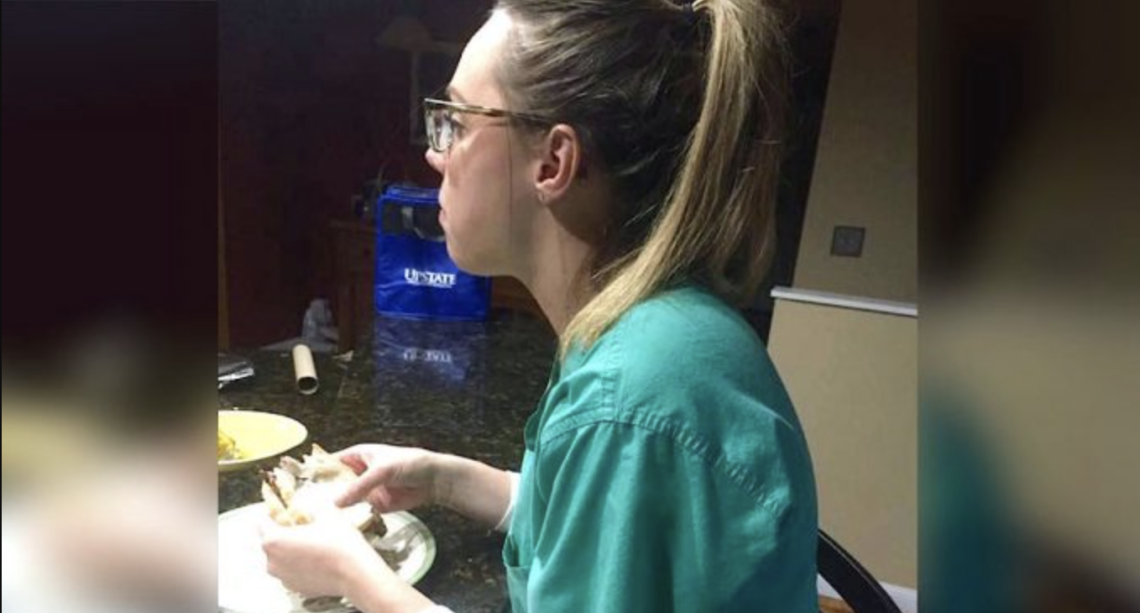
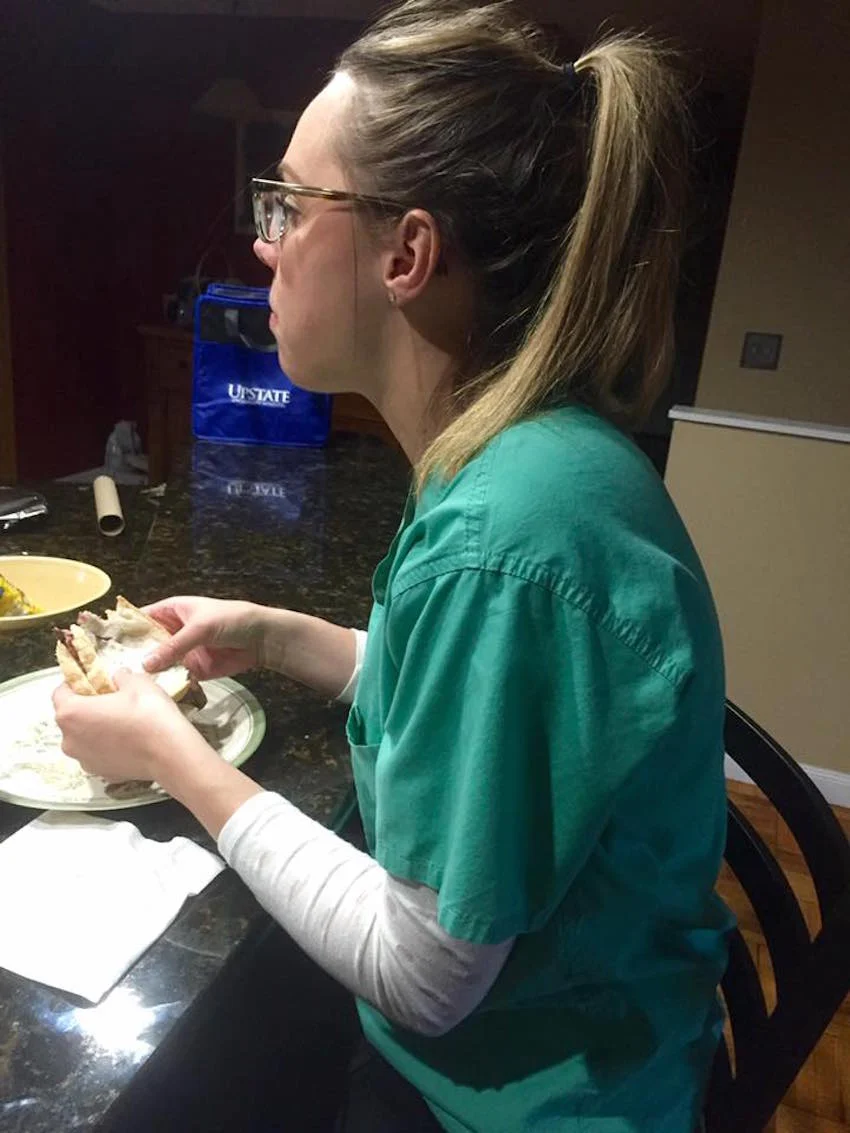
One evening, Philip watched his wife lower herself into a chair for dinner after spending 14 hours on her feet. That dinner was a sandwich. She ate, got herself ready for bed, and the next morning she did it all over again without a word of protest. It is easy to overlook the people closest to us — but Philip has never once taken his eyes off her.
Facebook / Philip Urtz
Here is what Philip wrote, in his own words:
“This is my wife Jessica having dinner after a 14-hour day. She gets home, barely has time to eat and wind down before bed, and then the next morning she is right back at it for another shift.”
“She is always up early, getting herself ready quietly. She prefers not to be disturbed in the morning and I completely understand that. She showers, pulls her hair back, grabs her lunch, gives both the dog and me a quick kiss, and walks out the door.”

Facebook / Philip Urtz
“The people she goes to work for are not having good days — not even close. She is there for stroke patients, for people recovering from car and motorcycle accidents, from falls, fractures, and serious brain injuries. She shows up for mothers and fathers, for siblings and friends, for entire families holding their breath in waiting rooms. It makes no difference to her who you are or how you ended up there. She will take care of you.”
“Lunch breaks are rare for her. Sitting down is even rarer. After 14 hours she finally comes through the door, slips off the shoes that have carried her through some of the heaviest moments imaginable, and all she wants is to rest for a while. I never push her to talk about her day — she keeps work at work and I respect that completely. But on the nights she does want to open up, I am right there and I am listening.”

Facebook / Philip Urtz
“There are evenings she walks in smiling and evenings she walks in carrying something heavy and invisible. Either way, her alarm goes off the next morning and she shows up again without fail. I love her more than I can put into words.”
“She is my hero. My wife is a Stroke Nurse.”
Not every partner notices. Not every partner says something even when they do. Philip did both — and that quiet, steady kind of love is something worth celebrating.

Facebook / Philip Urtz
This piece also draws inspiration from a post that spread widely across social media, written by Bobby Wesson as a tribute to his own wife, a nurse who carries the same quiet weight every day. His words sparked a conversation that many people clearly needed to have:
“My wife is taking a nap right now. In about an hour she will open her eyes, put on her scrubs, and start getting ready. She will gather everything she needs with care — checking and double-checking — and then spend a few quick minutes on her hair and makeup. She will tell me she looks terrible. I will tell her she is wrong, and I will hand her a coffee.
She will fold herself onto the couch, legs tucked underneath her, and try to drink it while our toddler climbs all over her like she is a jungle gym. She will laugh. And then, in the middle of a sentence, her eyes will go somewhere else for a moment — somewhere inside herself, quietly preparing for what is ahead. She thinks I do not catch it.

Facebook / Philip Urtz
She will hug our little one. She will kiss me. And then she will walk out the door to spend the next 14 hours with people who are living through the single worst day of their lives — accidents, serious injuries, burns, broken bones — people from every background and every circumstance, every profession, every age, every story. None of that determines whether she shows up for them. She will take care of you.
When she comes home, the shoes come off at the door — shoes that have been with her through exhaustion and heartbreak and things that cannot be unseen. She leaves them outside.
Some nights she does not want to say a single word about it. Other nights she cannot get it out fast enough. Sometimes the stories make her laugh so hard she cries. Sometimes she just cries. But no matter which kind of night it is, she will be ready and on time for her next shift.
My wife is a nurse. My wife is a hero.”
Source: Inspired by Philip Urtz’s tribute to his wife Jessica, originally shared on Facebook. Additional inspiration drawn from Bobby Wesson’s widely shared Facebook post honoring his nurse wife. Images via Philip Urtz / Facebook.